
इंग्लिश खबर
Day 4 at Goa Book Festival: Literature, Technology, Education and Creative Activities Take Centre Stage

-
/home/goakhabar/public_html/wp-content/plugins/mvp-social-buttons/mvp-social-buttons.php on line 117
- /home/goakhabar/public_html/wp-content/plugins/mvp-social-buttons/mvp-social-buttons.php on line 120
- /home/goakhabar/public_html/wp-content/plugins/mvp-social-buttons/mvp-social-buttons.php on line 123
- /home/goakhabar/public_html/wp-content/plugins/mvp-social-buttons/mvp-social-buttons.php on line 126
https://www.goakhabar.com/?p=109661&t=
Warning: Undefined variable $post in /home/goakhabar/public_html/wp-content/plugins/mvp-social-buttons/mvp-social-buttons.php on line 117
Warning: Attempt to read property "ID" on null in /home/goakhabar/public_html/wp-content/plugins/mvp-social-buttons/mvp-social-buttons.php on line 117
Day 4 at Goa Book Festival: Literature, Technology, Education and Creative Activities Take Centre Stage', 'facebookShare', 'width=626,height=436'); return false;" title="Share on Facebook">
Day 4 at Goa Book Festival: Literature, Technology, Education and Creative Activities Take Centre Stage &url=
Warning: Undefined variable $post in /home/goakhabar/public_html/wp-content/plugins/mvp-social-buttons/mvp-social-buttons.php on line 120
Warning: Attempt to read property "ID" on null in /home/goakhabar/public_html/wp-content/plugins/mvp-social-buttons/mvp-social-buttons.php on line 120
https://www.goakhabar.com/?p=109661', 'twitterShare', 'width=626,height=436'); return false;" title="Tweet This Post">
https://www.goakhabar.com/?p=109661&media=
Warning: Undefined variable $post in /home/goakhabar/public_html/wp-content/plugins/mvp-social-buttons/mvp-social-buttons.php on line 123
Warning: Attempt to read property "ID" on null in /home/goakhabar/public_html/wp-content/plugins/mvp-social-buttons/mvp-social-buttons.php on line 123
https://www.goakhabar.com/wp-content/uploads/2026/02/IMG-20260207-WA0150-590x354.jpg&description=
Warning: Undefined variable $post in /home/goakhabar/public_html/wp-content/plugins/mvp-social-buttons/mvp-social-buttons.php on line 123
Warning: Attempt to read property "ID" on null in /home/goakhabar/public_html/wp-content/plugins/mvp-social-buttons/mvp-social-buttons.php on line 123
Day 4 at Goa Book Festival: Literature, Technology, Education and Creative Activities Take Centre Stage', 'pinterestShare', 'width=750,height=350'); return false;" title="Pin This Post">
Day 4 at Goa Book Festival: Literature, Technology, Education and Creative Activities Take Centre Stage&BODY=I found this article interesting and thought of sharing it with you. Check it out:
Warning: Undefined variable $post in /home/goakhabar/public_html/wp-content/plugins/mvp-social-buttons/mvp-social-buttons.php on line 126
Warning: Attempt to read property "ID" on null in /home/goakhabar/public_html/wp-content/plugins/mvp-social-buttons/mvp-social-buttons.php on line 126
https://www.goakhabar.com/?p=109661">
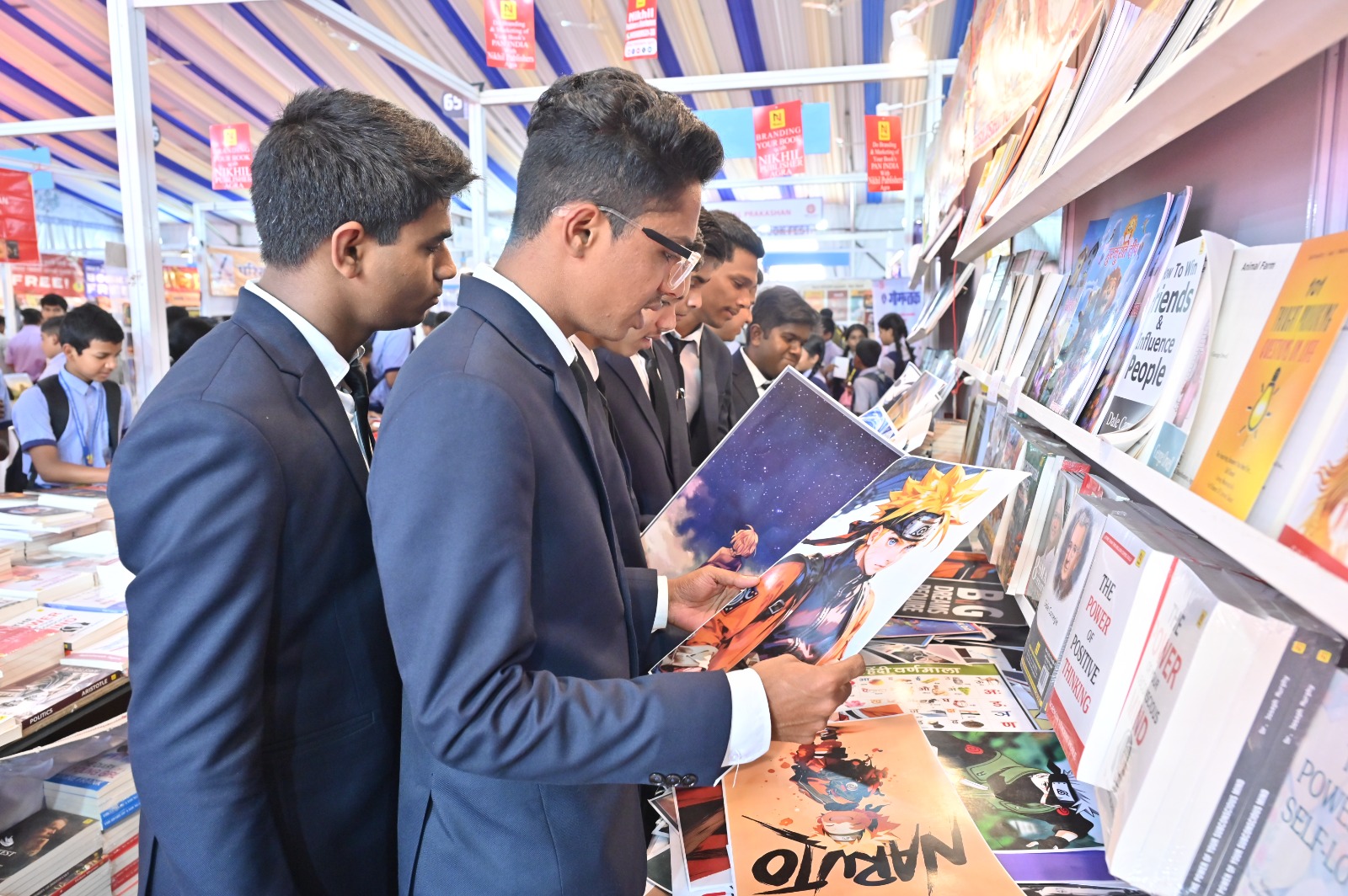
Goa Khabar: Day 4 at the Goa Book Festival promised a rich and reflective journey across literature, history, law, language, and the future of knowledge, bringing together some of the country’s most insightful voices. As the day unfolded, a steady stream of visitors filled the book fair at DB Bandodkar Grounds, Panaji, transforming the venue into a hub of culture. Families lingered over bookstalls, tourists wandered in drawn by curiosity, schoolchildren explored the world of books with visible excitement, and college students engaged thoughtfully with sessions and displays.
In the Author’s Corner, session “Stories of the Soul: Life, Death, and What Endures,” author Medha Khasgiwale, in conversation with Sanjay Chakrane, examined why human beings fear death and how this fear is rooted in identifying the self solely with the physical body. She spoke about the continuous cycle of death and renewal within the body at a cellular level, and introduced the idea of human existence as comprising the physical body, the subtle body (mind, intellect, and ego), and consciousness. Drawing from philosophical and spiritual traditions, the discussion distinguished between ego-driven identity and pure consciousness, arguing that death is not the end of existence but the withdrawal of conscious energy from the body.
This was followed by the session “Moving Towards Digital Library” was led by Dr. Sushant Tandel, Curator, Goa Central Library, who discussed how reading habits are evolving and how libraries must adapt to changing times. Addressing a gathering of librarians, he explained that while the internet offers vast amounts of information, the major challenge today is ensuring the authenticity and reliability of that information, highlighting the crucial role of librarians in verification and curation. Through his presentation, Dr. Tandel outlined the essential infrastructure of a digital library and spoke about the advantages of digital libraries such as access to vast resources and round-the-clock availability.
The next session, “Translation & Accessibility: Making Literature Inclusive” explored how translation and technology, including AI, can make literature more accessible to diverse audiences. In conversation with Purnanand Chari, Gopinath Vishnu Gawas highlighted how AI tools can assist in translation and content adaptation, while emphasizing that thoughtful, ethical use is crucial to preserve the essence and originality of texts. The discussion underlined that combining human insight with technological support can bridge linguistic gaps.
A Publishers’ Meet was held during the Goa Book Festival 2026 by the National Book Trust (NBT) under the Ministry of Education, in the presence of Shri Kiran Thakur, Chief Patron, Goa Book Festival, Shri N. Sampath, Assistant Director (Exhibitions), and Shri Ashok Dhankar, Project Officer. Around 35–40 publishers from across India, including Goa, participated in the session. Discussions focused on ISBN facilitation, support mechanisms for publishers, visibility of publications, and professional capacity building. Publishers shared suggestions to further streamline processes, strengthen national bibliographic systems, and expand training opportunities. The session reinforced NBT’s commitment to engaging with publishers and strengthening India’s publishing ecosystem.
In the session “A Discussion on After Me, Chaos: Astrology in the Mughal Empire,” journalist M. J. Akbar, in conversation with Vedanta Agarwal, examined the central role of astrology in Mughal governance and decision-making. Drawing on primary sources, he explained that astrology was not treated as superstition but as a rational tool consulted at moments of crisis such as war, rebellion, illness, succession, and exile. From Emperor Humayun’s reliance on astrologers during periods of defeat and displacement to Akbar’s institutionalisation of the post of Jyotiraj (chief court astrologer), astrological timing influenced military campaigns, coronations, daily schedules, and imperial policy. The session underscored astrology as an embedded administrative and cultural practice within the Mughal Empire.
In the next session, lawyer Sumant Batra discussed his book “The Life and Legacy of Arun Jaitley” in conversation with Vedanta Agrawal, highlighted three key reasons for undertaking the project: documenting the life of a statesman for future generations, showcasing Jaitley’s unique ability to build consensus across political divides, and his personal admiration for Jaitley’s career as a lawyer, policymaker, and leader. The discussion delved into how Jaitley’s early experiences, including his family’s migration from Lahore during Partition, his upbringing in Delhi, and his formative years in the Supreme Court, shaped his resilience, worldview, and appreciation for learning even from adversaries.
At the Children’s corner, waves of wonder, stories, riddles and creativity continued to gently hit the shore. Over 2500 students explored the art of character creation through “Let’s Design a Mascot” by Team NCCL, crafting innovative mascots for the e-library. In “Tell a Tale” by storyteller Akanksha Datta, young listeners worked through a fun, puzzling story of a mysterious puppeteer who spoke only in riddles, asking students to solve his riddles. The day concluded on a creative note with cartoonist Ajit Narayan conducting a “Cartoon Making Workshop”. Students were introduced to the basics of cartoon making, learning to create different expressions and faces using simple geometric shapes.
The day concluded with a powerful performance of ‘Shivpratap’, a grand musical-theatrical production that poetically traced the life and vision of Chhatrapati Shivaji Maharaj. Narrated through the voices of the Sahyadri mountains and the river Krishna, the performance brought history to life, highlighting Shivaji Maharaj’s journey from his birth and the guidance of Rajamata Jijabai to the challenges of oppression and the founding of Swarajya.
-
/home/goakhabar/public_html/wp-content/plugins/mvp-social-buttons/mvp-social-buttons.php on line 117
- /home/goakhabar/public_html/wp-content/plugins/mvp-social-buttons/mvp-social-buttons.php on line 120
- /home/goakhabar/public_html/wp-content/plugins/mvp-social-buttons/mvp-social-buttons.php on line 123
- /home/goakhabar/public_html/wp-content/plugins/mvp-social-buttons/mvp-social-buttons.php on line 126
https://www.goakhabar.com/?p=109661&t=
Warning: Undefined variable $post in /home/goakhabar/public_html/wp-content/plugins/mvp-social-buttons/mvp-social-buttons.php on line 117
Warning: Attempt to read property "ID" on null in /home/goakhabar/public_html/wp-content/plugins/mvp-social-buttons/mvp-social-buttons.php on line 117
Day 4 at Goa Book Festival: Literature, Technology, Education and Creative Activities Take Centre Stage', 'facebookShare', 'width=626,height=436'); return false;" title="Share on Facebook">
Day 4 at Goa Book Festival: Literature, Technology, Education and Creative Activities Take Centre Stage &url=
Warning: Undefined variable $post in /home/goakhabar/public_html/wp-content/plugins/mvp-social-buttons/mvp-social-buttons.php on line 120
Warning: Attempt to read property "ID" on null in /home/goakhabar/public_html/wp-content/plugins/mvp-social-buttons/mvp-social-buttons.php on line 120
https://www.goakhabar.com/?p=109661', 'twitterShare', 'width=626,height=436'); return false;" title="Tweet This Post">
https://www.goakhabar.com/?p=109661&media=
Warning: Undefined variable $post in /home/goakhabar/public_html/wp-content/plugins/mvp-social-buttons/mvp-social-buttons.php on line 123
Warning: Attempt to read property "ID" on null in /home/goakhabar/public_html/wp-content/plugins/mvp-social-buttons/mvp-social-buttons.php on line 123
https://www.goakhabar.com/wp-content/uploads/2026/02/IMG-20260207-WA0150-590x354.jpg&description=
Warning: Undefined variable $post in /home/goakhabar/public_html/wp-content/plugins/mvp-social-buttons/mvp-social-buttons.php on line 123
Warning: Attempt to read property "ID" on null in /home/goakhabar/public_html/wp-content/plugins/mvp-social-buttons/mvp-social-buttons.php on line 123
Day 4 at Goa Book Festival: Literature, Technology, Education and Creative Activities Take Centre Stage', 'pinterestShare', 'width=750,height=350'); return false;" title="Pin This Post">
Day 4 at Goa Book Festival: Literature, Technology, Education and Creative Activities Take Centre Stage&BODY=I found this article interesting and thought of sharing it with you. Check it out:
Warning: Undefined variable $post in /home/goakhabar/public_html/wp-content/plugins/mvp-social-buttons/mvp-social-buttons.php on line 126
Warning: Attempt to read property "ID" on null in /home/goakhabar/public_html/wp-content/plugins/mvp-social-buttons/mvp-social-buttons.php on line 126
https://www.goakhabar.com/?p=109661">