

गोवा खबर
Goa Police launches Cyber-Yoddha programme

-
/home/goakhabar/public_html/wp-content/plugins/mvp-social-buttons/mvp-social-buttons.php on line 117
- /home/goakhabar/public_html/wp-content/plugins/mvp-social-buttons/mvp-social-buttons.php on line 120
- /home/goakhabar/public_html/wp-content/plugins/mvp-social-buttons/mvp-social-buttons.php on line 123
- /home/goakhabar/public_html/wp-content/plugins/mvp-social-buttons/mvp-social-buttons.php on line 126
https://www.goakhabar.com/?p=100563&t=
Warning: Undefined variable $post in /home/goakhabar/public_html/wp-content/plugins/mvp-social-buttons/mvp-social-buttons.php on line 117
Warning: Attempt to read property "ID" on null in /home/goakhabar/public_html/wp-content/plugins/mvp-social-buttons/mvp-social-buttons.php on line 117
Goa Police launches Cyber-Yoddha programme', 'facebookShare', 'width=626,height=436'); return false;" title="Share on Facebook">
Goa Police launches Cyber-Yoddha programme &url=
Warning: Undefined variable $post in /home/goakhabar/public_html/wp-content/plugins/mvp-social-buttons/mvp-social-buttons.php on line 120
Warning: Attempt to read property "ID" on null in /home/goakhabar/public_html/wp-content/plugins/mvp-social-buttons/mvp-social-buttons.php on line 120
https://www.goakhabar.com/?p=100563', 'twitterShare', 'width=626,height=436'); return false;" title="Tweet This Post">
https://www.goakhabar.com/?p=100563&media=
Warning: Undefined variable $post in /home/goakhabar/public_html/wp-content/plugins/mvp-social-buttons/mvp-social-buttons.php on line 123
Warning: Attempt to read property "ID" on null in /home/goakhabar/public_html/wp-content/plugins/mvp-social-buttons/mvp-social-buttons.php on line 123
https://www.goakhabar.com/wp-content/uploads/2025/02/IMG-20250218-WA0027-590x354.jpg&description=
Warning: Undefined variable $post in /home/goakhabar/public_html/wp-content/plugins/mvp-social-buttons/mvp-social-buttons.php on line 123
Warning: Attempt to read property "ID" on null in /home/goakhabar/public_html/wp-content/plugins/mvp-social-buttons/mvp-social-buttons.php on line 123
Goa Police launches Cyber-Yoddha programme', 'pinterestShare', 'width=750,height=350'); return false;" title="Pin This Post">
Goa Police launches Cyber-Yoddha programme&BODY=I found this article interesting and thought of sharing it with you. Check it out:
Warning: Undefined variable $post in /home/goakhabar/public_html/wp-content/plugins/mvp-social-buttons/mvp-social-buttons.php on line 126
Warning: Attempt to read property "ID" on null in /home/goakhabar/public_html/wp-content/plugins/mvp-social-buttons/mvp-social-buttons.php on line 126
https://www.goakhabar.com/?p=100563">
Goa Khabar : In a significant step towards enhancing cyber security, leveraging artificial intelligence, and improving traffic compliance, Goa Police today launched four pioneering initiatives namely Dedicated Cyber Helpline Center (1930), Cyber-Yoddha Programme, AI-ML Lab, and Quick Pass Mobile Application.
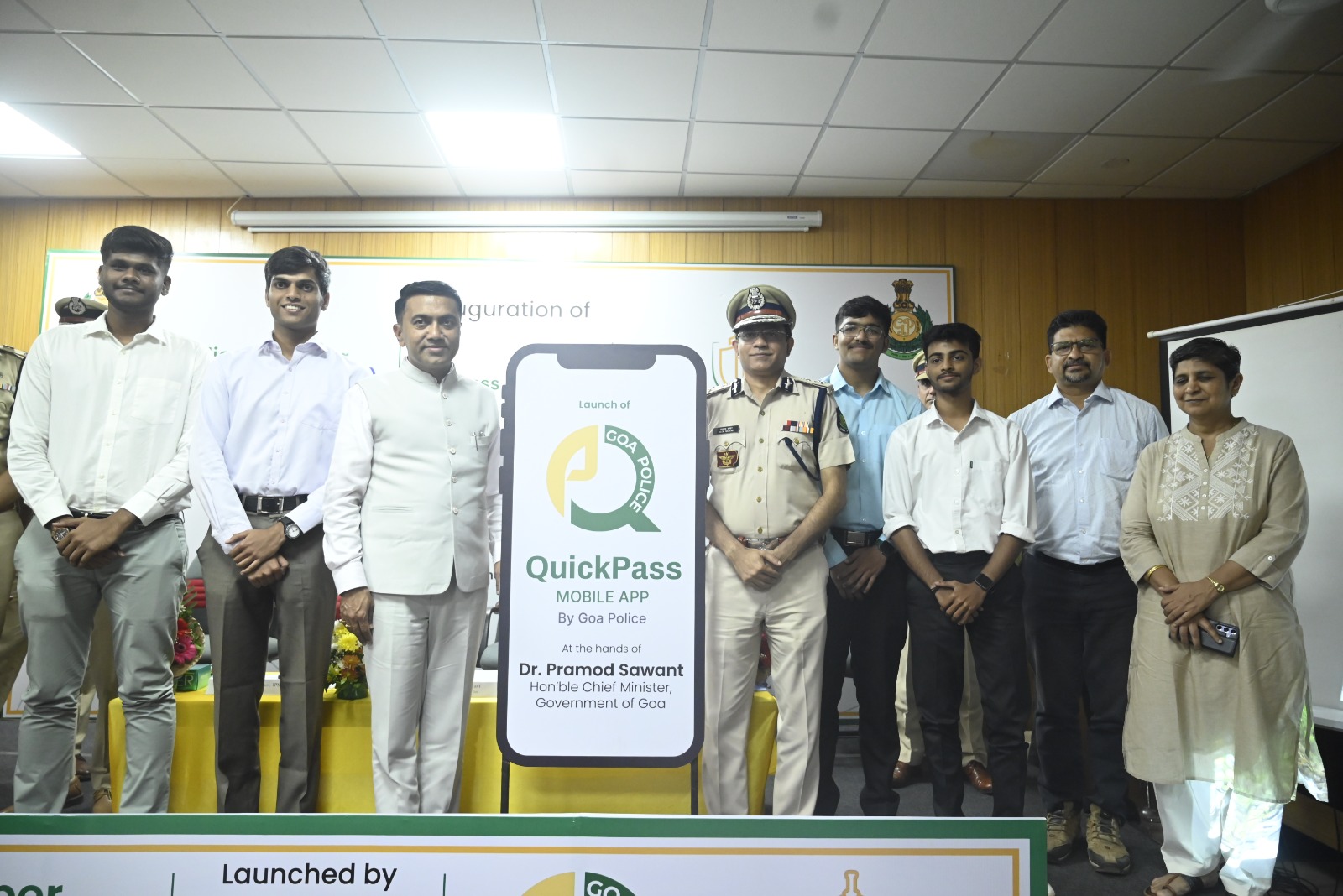
The launch event was graced by the Hon’ble Chief Minister of Goa, Dr. Pramod Sawant, in the presence of DGP Goa, Alok Kumar, IPS, IGP Goa, Omvir Singh, IPS, DIGP (HQ) Ajay Krishan Sharma, IPS, SP Crime, Rahul Gupta, IPS, SP Traffic, Prabodh Shirvoikar, along with other senior officers, police personnel, media representatives, and approximately 120 Cyber-Yoddhas.
The Cyber-Yoddha Programme is a unique community-driven initiative under Cyber Surakshit Goem campaign aimed at empowering trained volunteers from different sectors of society, including students, media professionals, teachers, NGOs, and senior citizens, to act as cyber awareness ambassadors. These volunteers will be trained by the Cyber Police Station to understand cybercrime trends, identify threats, and educate the public on preventive measures.
The program follows a structured model where Cyber-Yoddhas will conduct awareness sessions in coordination with Beat Officers and Cyber Teams of Police stations across Goa, ensuring widespread outreach and continuous engagement with law enforcement. This is a unique model where college students and Civil Society Organisations have come forward with Police to fight against cyber crime. These colleges include Goa College of Home Science, Government College Khadola Marcel, Government College of Quepem, Father Agnel College of Arts and Commerce, Goa College of Music, Altinho Panaji, Rosary College of Commerce and Art, Narayan Zantye College of Commerce, Bicholim, NIT Goa, Dr. Dada Vaidya College of Eductaion Farmagudi Ponda, MES Vasant Joshi College of Arts and Commerce Zuarinagar.

Recognizing the growing role of Artificial Intelligence (AI) and Machine Learning (ML) in law enforcement, Goa Police has established an AI-ML Lab at Crime Branch, Ribandar, in collaboration with Samruddh Bharat Technologies Pvt Ltd, a Goa-based AI solutions startup. This lab will focus on developing AI-driven projects to enhance policing and cyber security, including an AI-powered Help Desk at police stations, AI tools for identifying and blocking malicious content, and crime prediction models using Machine Language.
The AI-ML Lab will also contribute to automating operations at the Police Control Room ERSS-112, improving response time and operational efficiency. The lab will be supervised by SP Crime, Goa Police, and will include a dedicated team of police personnel and AI experts. Goa Police is one of the few states to have this kind of AI-ML Lab amongst the countries Law Enforcement Agencies.

To enhance traffic compliance and reduce inconvenience for motorists, Goa Police introduced the Quick Pass Mobile Application, which allows drivers to generate a QR code as proof of compliance, eliminating the need for repeated document verification at traffic checkpoints. Once a QR code is issued, it is valid for 12 hours until there is any visible violation by the commuter. This application will streamline traffic enforcement by providing instant QR code generation for compliant vehicles, simplified verification for police officers, and an admin dashboard for real-time traffic data analysis, including geotagging and violation hotspot mapping. This is first such app developed by a state in the country. Goa Police is confident that this solution will be emulated by other tourist states in the country.
As a part of its commitment to strengthening cybercrime response, Goa Police has also revamped the 1930 Cyber Crime Helpline. The helpline has been shifted from SPCR Panaji to Cyber Crime PS to establish greater accountability and improved coordination with Investigation Teams. Two dedicated phone lines are operational 24×7 to assist citizens with cyber fraud and online crime complaints. A team of nine dedicated personnel, working in three shifts, ensures round-the-clock response. Each operator is equipped with an individual computer system to swiftly log complaints into the National Cybercrime Reporting Portal (NCRP), enabling rapid action by law enforcement agencies and financial institutions.

Speaking at the event, Hon’ble Chief Minister, Dr. Pramod Sawant, praised Goa Police for its proactive approach in integrating technology and community engagement into policing. He emphasized that these initiatives would significantly improve cyber security, foster public trust, and enhance the overall efficiency of law enforcement. HCM Commended Cyber cell and Goa Police for taking technological initiative. He mentioned that Cyber cell has been proactive in blocking the illegal content and malicious platforms as and when they are reported by people to 1930 helpline.
HCM urged the citizens to report Cyber Frauds immediately to ensure that money is frozen in the bank accounts given by the fraudsters. HCM commended students and faculty of Padre Conceicao College of Engineering for developing pioneering QuickPass app for traffic management and preventing harassment of commuters. It is an initiative taken by Goa’s students which is first of its kind taken by tourist states in the country. HCM announced that increased incentives will be given to Cyber Yoddhas in due course.
DGP Goa, Alok Kumar, IPS, reiterated the importance of AI-driven solutions and community participation in modern policing and affirmed Goa Police’s commitment to leveraging technology for public safety and crime prevention. He highlighted various initiatives taken by Goa Police in last few months when it comes to embracing technology viz. TRACK Center, QR code based public feedback, Successful Hackathon 2024, Use of Bhashini app and so on.
The launch of these initiatives marks a major milestone in Goa Police’s efforts towards cybercrime prevention, AI driven law enforcement, and efficient traffic management. These programs are expected to enhance digital literacy and improve operational efficiency.
-
/home/goakhabar/public_html/wp-content/plugins/mvp-social-buttons/mvp-social-buttons.php on line 117
- /home/goakhabar/public_html/wp-content/plugins/mvp-social-buttons/mvp-social-buttons.php on line 120
- /home/goakhabar/public_html/wp-content/plugins/mvp-social-buttons/mvp-social-buttons.php on line 123
- /home/goakhabar/public_html/wp-content/plugins/mvp-social-buttons/mvp-social-buttons.php on line 126
https://www.goakhabar.com/?p=100563&t=
Warning: Undefined variable $post in /home/goakhabar/public_html/wp-content/plugins/mvp-social-buttons/mvp-social-buttons.php on line 117
Warning: Attempt to read property "ID" on null in /home/goakhabar/public_html/wp-content/plugins/mvp-social-buttons/mvp-social-buttons.php on line 117
Goa Police launches Cyber-Yoddha programme', 'facebookShare', 'width=626,height=436'); return false;" title="Share on Facebook">
Goa Police launches Cyber-Yoddha programme &url=
Warning: Undefined variable $post in /home/goakhabar/public_html/wp-content/plugins/mvp-social-buttons/mvp-social-buttons.php on line 120
Warning: Attempt to read property "ID" on null in /home/goakhabar/public_html/wp-content/plugins/mvp-social-buttons/mvp-social-buttons.php on line 120
https://www.goakhabar.com/?p=100563', 'twitterShare', 'width=626,height=436'); return false;" title="Tweet This Post">
https://www.goakhabar.com/?p=100563&media=
Warning: Undefined variable $post in /home/goakhabar/public_html/wp-content/plugins/mvp-social-buttons/mvp-social-buttons.php on line 123
Warning: Attempt to read property "ID" on null in /home/goakhabar/public_html/wp-content/plugins/mvp-social-buttons/mvp-social-buttons.php on line 123
https://www.goakhabar.com/wp-content/uploads/2025/02/IMG-20250218-WA0027-590x354.jpg&description=
Warning: Undefined variable $post in /home/goakhabar/public_html/wp-content/plugins/mvp-social-buttons/mvp-social-buttons.php on line 123
Warning: Attempt to read property "ID" on null in /home/goakhabar/public_html/wp-content/plugins/mvp-social-buttons/mvp-social-buttons.php on line 123
Goa Police launches Cyber-Yoddha programme', 'pinterestShare', 'width=750,height=350'); return false;" title="Pin This Post">
Goa Police launches Cyber-Yoddha programme&BODY=I found this article interesting and thought of sharing it with you. Check it out:
Warning: Undefined variable $post in /home/goakhabar/public_html/wp-content/plugins/mvp-social-buttons/mvp-social-buttons.php on line 126
Warning: Attempt to read property "ID" on null in /home/goakhabar/public_html/wp-content/plugins/mvp-social-buttons/mvp-social-buttons.php on line 126
https://www.goakhabar.com/?p=100563">