इंग्लिश खबर
Under the Blue Sky We Are All Equal: Mixed Media Artist Bakery Prasad Debut Exhibition Spotlights Dalit Cause

Goa Khabar : The colour blue, symbolic of the Dalit movement in India, and digital prints, animated films and family artefacts linked to India’s marginalised communities took centrestage at Siddhesh Gautam aka Bakery Prasad’s debut solo exhibition, ‘We The People (Too),’at the Museum of Goa (MOG) in Pilerne, which was unveiled on Sunday, August 25.
Speaking at the weekly MOG Sunday talk, Gautam said that the colour blue, a predominant feature of his mixed-media artworks, is inspired by Dr. Babasaheb Ambedkar’s belief that “Under the blue sky, we are all equal”.
“My art is a dialogue with history and society. It’s about questioning how far we’ve come in achieving true freedom and equality. The exhibition is a reflection on the progress we’ve made and the challenges that remain,” said Gautam, whose artist name ‘Bakery Prasad’ stems from his fondness for baked goods.

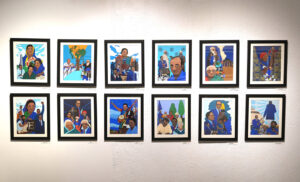
n exhibit from ‘We the People (too),’ a debut solo exhibition by internationally renowned Delhi-based mixed media Ambedkarite artist Siddhesh Gautam aka Bakery Prasad, on display at the Museum of Goa, Pilerne. The exhibition will culminate on September 8.
His grandfather, Gautam said, is the major inspiration behind his distinct art style. Orphaned at the age of five, his grandfather began commissioning local artists for portraits of him and his father, sparking Gautam’s interest.
Freedom, according to Gautam, is subjective and every person in this world seeks some or the other kind of freedom. And for Dalit people in India, freedom is as basic as being considered a human being. “We just want to be acknowledged as humans, not as Dalit people or broken people. We come in every colour, shape and size. We are as human as anybody else. We are as evil as any other human. We are as generous as any other human. But to be considered a human is very important,” said Gautam, who has lectured at various universities and colleges, including Tufts University in New York, Oxford University and the School of Oriental and African Studies, United Kingdom, the University of Vienna and the Hague-based International Institute of Social Studies.
Further speaking about his exhibition, Gautam said that the core thought behind it was to start a discussion on the variability of freedom. “Basically, the idea was to discuss what freedom means to different sorts of people,” said Delhi-based Gautam.