इंग्लिश खबर
Goa < 2075: Writing Live Fiction, Set in Reality, can Challenge Journalism on its Turf : Mayabhushan Nagvenkar

Goa Khabar : Exploring Goa’s ever-changing cultural, social landscape via a live, bilingual and futuristic novel which is rooted in contemporary facts, has enabled a breakaway from the futility and lack of purpose of modern-day journalism, stated Goan author and former journalist Mayabhushan Nagvenkar.
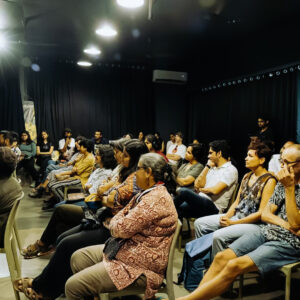
Nagvenkar offered audiences insights into India’s first live, bilingual novel titled ‘Goa < 2075’ which also marks his debut in fiction, at the recently held MOG Sundays talk titled, ‘Imagine Goa, Fifty Years Hence’ at the Museum of Goa (MOG), Pilerne. Nagvenkar was in conversation with eminent filmmaker Qaushiq Mukherjee, known as Q.
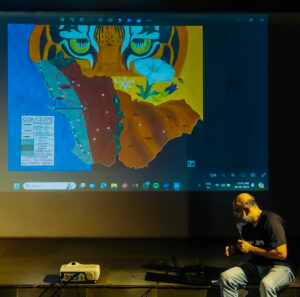


Dystopian in nature, ‘Goa < 2075,’ self-published by Nagvenkar on various social media platforms, follows the journey of five friends aiming to avenge their friends slain for protecting the last standing traditional house in Anjuna, while navigating a radically different geographical, political and social landscape of the future, consisting of powerful Overlords and underground-dwelling Subterraneans. Set in Goa in the year 2075, which is ruled by a Corporation instead of an elected government, where only the rich are empowered by law to live on the surface and where the fate of the state’s last surviving tigress is in peril, the novel follows the trope of vigilante justice as a means for social change.


Nagvenkar’s representation of the faltering ethics of journalism is embodied through the character of a journalist in the ongoing novel, who is unable to perform the fundamentals of his role due to pressure from the Overlords and ideological conflict.
“Placing a version of contemporary Goa in the future gives me the liberty to explore and flesh out my characters and subjects more and stretch the plot of my novel. I think with this format, I get the freedom to explore all sides of an issue or story, which often doesn’t happen in reality,” said Nagvenkar, who made a mid-career switch from journalism to fiction writing.
Nagvenkar’s pioneering mode of publication was also highlighted by filmmaker Q, aligning with the current deficiency in people’s attention span by utilising the space of social media to release small portions of the story four times a week – twice in English and the same pieces translated into Marathi to capture a wider audience.
“We all know about the attention economy at present, which has majorly changed because of the Internet since 2014 onwards, where algorithms now decide your content for you. Our power of choice is being limited, and Nagvenkar’s live novel format attempts to bridge that gap by providing substance in smaller packages,” stated Q.
Drafting a ‘live’ novel necessitates finding a rhythm while writing and posting, which Nagvenkar achieves by posting every Wednesday and Saturday.
“I know what will happen in the next instalment, but I haven’t written it yet, and the same goes for the later portions of the novel. I have an end-to-end trajectory; however, in the course of writing, I tweak sub-plots to include contemporary occurrences,” said Nagvenkar.
Nagvenkar explores several platforms for publication but has found a keen audience on Instagram.
“On Instagram, which has an active user base of two billion, I utilise intriguing creatives as covers to pique audience interest, and a ‘beginning, middle and end’ structure for the content portions drafted to give more context, but leave readers wanting more simultaneously,” stated Nagvenkar.