इंग्लिश खबर
India@2047: A New Opportunity for Muslim Youth

India’s journey towards 2047, when the country will celebrate the centenary of Independence, is not merely about achieving a government vision or meeting an economic target. It is an opportunity for every citizen to participate in building a stronger, more prosperous and more confident nation. For India’s Muslim community, particularly its younger generation, this journey offers an important opportunity to transform education, technology, entrepreneurship and leadership into instruments of progress.
The India of 2047 will be significantly different from the India of today. Artificial intelligence, advanced manufacturing, biotechnology, digital services, clean energy, space technology and other emerging sectors are expected to reshape both the economy and the nature of employment. Young people who acquire the right skills, remain adaptable and embrace innovation will have access to opportunities that earlier generations could scarcely imagine.

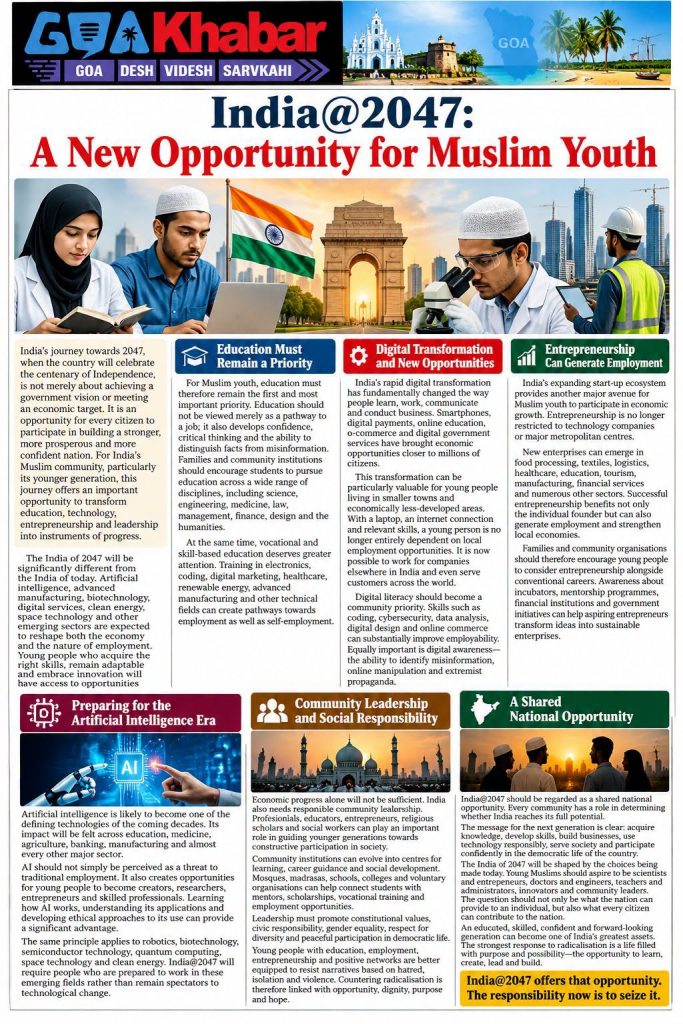
For Muslim youth, education must therefore remain the first and most important priority. Education should not be viewed merely as a pathway to a job; it also develops confidence, critical thinking and the ability to distinguish facts from misinformation. Families and community institutions should encourage students to pursue education across a wide range of disciplines, including science, engineering, medicine, law, management, finance, design and the humanities.
At the same time, vocational and skill-based education deserves greater attention. Training in electronics, coding, digital marketing, healthcare, renewable energy, advanced manufacturing and other technical fields can create pathways towards employment as well as self-employment.
Digital Transformation and New Opportunities
India’s rapid digital transformation has fundamentally changed the way people learn, work, communicate and conduct business. Smartphones, digital payments, online education, e-commerce and digital government services have brought economic opportunities closer to millions of citizens.
This transformation can be particularly valuable for young people living in smaller towns and economically less-developed areas. With a laptop, an internet connection and relevant skills, a young person is no longer entirely dependent on employment opportunities available in the immediate locality. It is now possible to work for companies located elsewhere in India and even serve customers across the world.
Digital literacy should consequently become a community priority. Skills such as coding, cybersecurity, data analysis, digital design and online commerce can substantially improve employability. Equally important is digital awareness—the ability to identify misinformation, online manipulation and extremist propaganda.
Entrepreneurship Can Generate Employment
India’s expanding start-up ecosystem provides another major avenue for Muslim youth to participate in economic growth. Entrepreneurship is no longer restricted to technology companies or major metropolitan centres.
New enterprises can emerge in food processing, textiles, logistics, healthcare, education, tourism, manufacturing, financial services and numerous other sectors. Successful entrepreneurship benefits not only the individual founder but can also generate employment and strengthen local economies.
Families and community organisations should therefore encourage young people to consider entrepreneurship alongside conventional careers. Awareness about incubators, mentorship programmes, financial institutions and government initiatives can help aspiring entrepreneurs transform ideas into sustainable enterprises.
Preparing for the Artificial Intelligence Era
Artificial intelligence is likely to become one of the defining technologies of the coming decades. Its impact will be felt across education, medicine, agriculture, banking, manufacturing and almost every other major sector.
AI should not simply be perceived as a threat to traditional employment. It also creates opportunities for young people to become creators, researchers, entrepreneurs and skilled professionals. Learning how AI works, understanding its applications and developing ethical approaches to its use can provide a significant advantage.
The same principle applies to robotics, biotechnology, semiconductor technology, quantum computing, space technology and clean energy. India@2047 will require people who are prepared to work in these emerging fields rather than remain spectators to technological change.
Community Leadership and Social Responsibility
Economic progress alone, however, will not be sufficient. India also requires responsible community leadership. Professionals, educators, entrepreneurs, religious scholars and social workers can play an important role in guiding younger generations towards constructive participation in society.
Community institutions can evolve into centres for learning, career guidance and social development. Mosques, madrasas, schools, colleges and voluntary organisations can help connect students with mentors, scholarships, vocational training and employment opportunities.
Leadership must simultaneously promote constitutional values, civic responsibility, gender equality, respect for diversity and peaceful participation in democratic life. These principles are particularly relevant in efforts to counter radicalisation.
Young people with access to education, meaningful employment, entrepreneurship and positive community networks are better equipped to resist narratives based on hatred, isolation and violence. Countering radicalisation is therefore not merely a security challenge; it is also fundamentally connected with opportunity, dignity, purpose and hope.
A Shared National Opportunity
India@2047 should ultimately be regarded as a shared national opportunity. Every community has a role in determining whether India reaches its full potential.
The message for the next generation is clear: acquire knowledge, develop skills, build businesses, use technology responsibly, serve society and participate confidently in the democratic life of the country.
The India of 2047 will be shaped by the choices being made today. Young Muslims should aspire to become scientists and entrepreneurs, doctors and engineers, teachers and administrators, innovators and community leaders. The question should not only be what the nation can provide to an individual, but also what every citizen can contribute to the nation.
An educated, skilled, confident and forward-looking generation can become one of India’s greatest assets. The strongest response to radicalisation is ultimately a life filled with purpose and possibility—the opportunity to learn, create, lead and build.
India@2047 offers that opportunity. The responsibility now is to seize it.